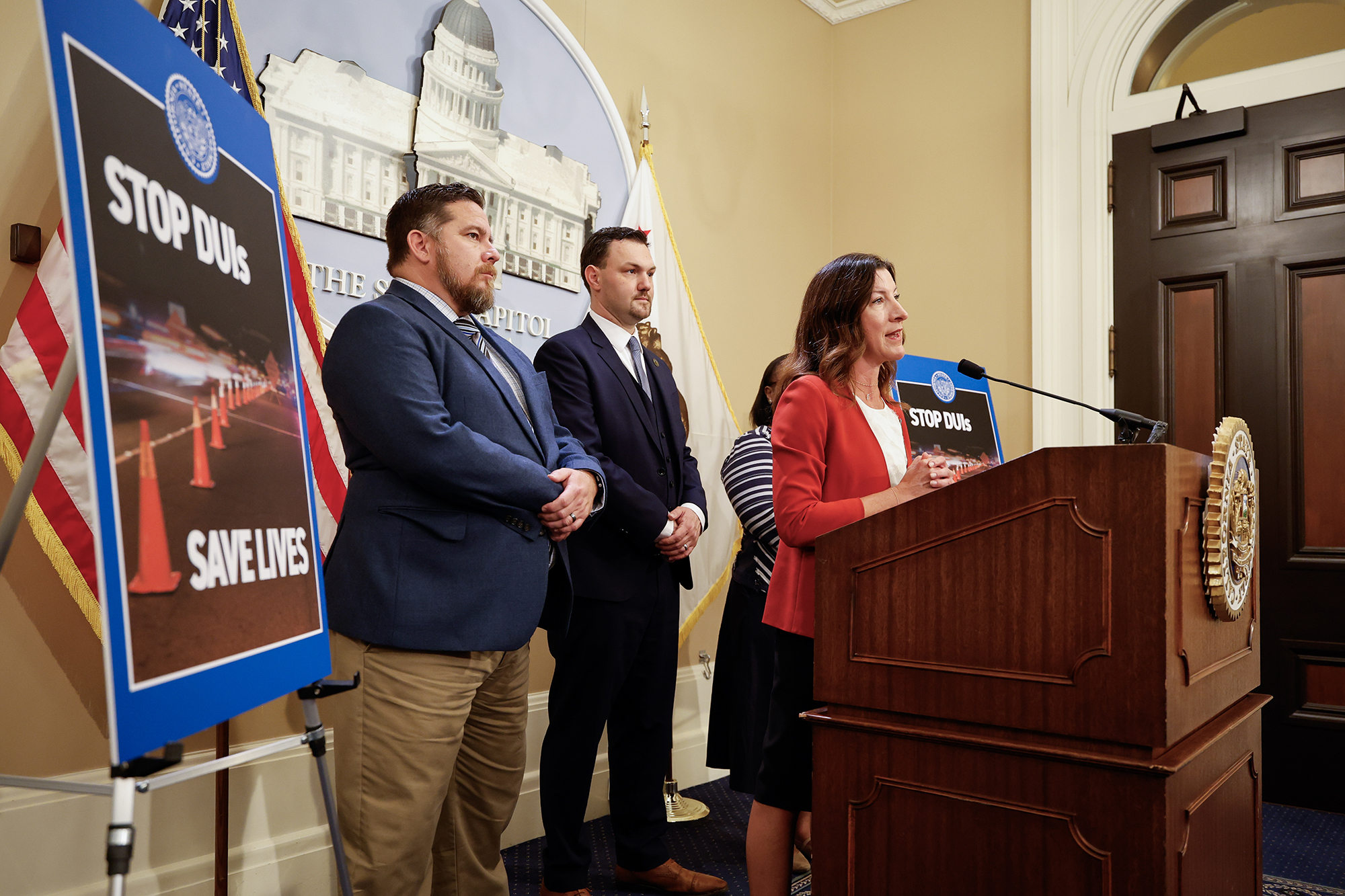
<!-- Creative Commons Attribution-NonCommercial-NoDerivatives https://creativecommons.org/licenses/by-nc-nd/4.0/ --></p> <p>from <a href=""https://calmatters.org/author/andrew-donohue/"" title=""Posts" by="" andrew="" donohue="" class=""author" url="" fn="" rel=""author"">Andrew Donohue</a>CalMatters</p> <figure> <img decoding="async" width=""1200"" height=""800"" src=""https://i0.wp.com/calmatters.org/wp-content/uploads/2026/02/020226-DUI-Laws-FG-CM-02-1.jpg?fit=1200%2C800&ssl=1"" class=""attachment-post-thumbnail" size-post-thumbnail="" wp-post-image="" alt=""A" person="" in="" a="" red="" blazer="" speaks="" at="" wooden="" podium="" inside="" government="" building="" with="" three="" people="" standing="" behind="" them="" and="" large="" posters="" reading="" duis="" lives="" showing="" traffic="" cones="" flashing="" lights="" on="" either="" side="" of="" the="" group.="" decoding=""async"" loading=""lazy"" srcset=""https://i0.wp.com/calmatters.org/wp-content/uploads/2026/02/020226-DUI-Laws-FG-CM-02-1.jpg?w=2000&ssl=1" https:="" sizes=""auto,"/><figcaption>Flanked by Democratic and Republican lawmakers, Assemblyman Coty Petrie-Norris addresses the media at the state Capitol in Sacramento about a series of bills aimed at reducing deaths and injuries in the state on February 2, 2026. Photo by Fred Greaves for CalMatters</figcaption></figure> <p>This story was originally published by <a href=""https://calmatters.org/"">CalMatters</a>. <a href=""https://calmatters.org/subscribe-to-calmatters/"">Sign up</a> for their newsletters.</p> <p>About half of the 17 laws proposed this year to address California’s dangerous driving epidemic remain alive in the Legislature after an initial wave of policy hearings and key votes in Sacramento. </p> <p>Now the remaining eight bills move to opposite chambers of the state legislature, a leap that has previously proven difficult for similar measures. </p> <p>Public hearings on the bills this spring revealed a clear divide. </p> <p>On one side: the families of crash victims and lawmakers who want to see tougher consequences for the kinds of dangerous — and often deadly — drivers who <a href=""https://calmatters.org/series/license-to-kill/"" type=""link"">California allowed it to stay</a> on the road. </p> <p>On the other side: progressive groups like the ACLU, which instead call for a greater emphasis on road design and other traffic-calming measures.</p> <p>At a recent Assembly committee hearing, Danica Rodarmel spoke out against the expansion of mandatory dragnets for DUI offenders on behalf of Debt Free Justice California. She said such proposals were too “expensive and difficult to navigate for many people”.</p> <p>“If we’re serious about prevention, we need to design systems that are easy for people to comply with,” Rodarmel said at an Assembly Public Safety Committee hearing in March. “I also understand that those concerns sound really minor when you’re talking about it compared to life.” </p> <p>Assemblywoman Coty Petrie-Norris, a Democrat from Southern California, who for the third time has introduced a bill to expand the use of in-car breathalyzers, saw common ground on at least one point.</p> <p>“I think you said the concerns sound ‘minor compared to what’s at stake and what’s on the line,'” Petrie-Norris said. </p> <p>“I couldn’t agree more with that sentiment.”</p> <p>Here’s an overview of the status of all 17 bills:</p> <h4><strong>BILL’S STATUS: STILL ALIVE</strong></h4> <ul> <li><strong>Close the diversion hatch</strong>: California has a diversion program that is supposed to allow low-level offenders to avoid the collateral consequences of a criminal conviction. However, judges grant it to drivers accused of killing someone with their car, resulting in the cases never being reported to the DMV. Drivers then maintain clean records. That’s what it means <a href=""https://calmatters.org/investigation/2025/12/california-vehicular-manslaughter-diversion/?series=license-to-kill"">you can get a harsher punishment</a> for a speeding ticket than for killing someone with your car. (<a href=""https://calmatters.digitaldemocracy.org/bills/ca_202520260ab1662"">AB1662</a> and <a href=""https://calmatters.digitaldemocracy.org/bills/ca_202520260sb953"">SB953</a>)</li> <li><strong>Extending Dredger Mandates</strong>: Most states require all drivers convicted of DUI to install a device called an ignition immobilizer in the car. California lawmakers have tried and failed multiple times to mandate them for all DUIs here as well. Currently, they are still only required for repeat offenses or injury crashes, a weaker standard that the courts <a href=""https://calmatters.org/investigation/2025/10/california-dui-failure/"">they still often fail to establish themselves</a>. (<a href=""https://calmatters.digitaldemocracy.org/bills/ca_202520260ab1830"">AB1830</a>)</li> <li><strong>Increasing penalties for repeat DUIs</strong>: It usually takes a driver to get four DUIs within 10 years for California prosecutors to charge them with a felony. This bill would make a third DUI in that period a “non-statutory” felony, meaning prosecutors would have the ability to file stiffer charges and more jail time sooner. The measure would also expand breathalyzer requirements or license suspensions for drivers with four or more DUIs within a decade. (<a href=""https://calmatters.digitaldemocracy.org/bills/ca_202520260ab1546"">AB1546</a>)</li> <li><strong>Longer stops and detention of a vehicle for reckless driving: </strong>This bill increases the license suspension period and the amount of time a driver’s vehicle can be impounded after reckless driving convictions. (<a href=""https://calmatters.digitaldemocracy.org/bills/ca_202520260sb1198"">SB1198</a>)</li> </ul> <p><strong>ACCOUNT STATUS: </strong><strong>ALIVE BUT WATERED</strong></p> <ul> <li><strong>Tougher penalties for DUI</strong>: This bill originally had five main provisions. The three still alive would add jail time to some DUI repeat offenders, increase penalties for hit-and-runs if the driver had a prior DUI, and make it easier to charge repeat drunk drivers with homicide if they kill someone. The two provisions removed from the bill would have added vehicular manslaughter to the list of “violent” crimes — ensuring that such drivers would have to serve more than their sentence behind bars if convicted — and added jail time for fatal multi-casualty crashes. (<a href=""https://calmatters.digitaldemocracy.org/bills/ca_202520260sb907"">SB907</a>)</li> <li><strong>Increase points for vehicular manslaughter</strong>: Currently, a vehicular manslaughter conviction only counts as two points on your driver’s license. (The penalty for speeding is one point. Four points are required in a 12-month period before a driver’s license is suspended.) The original version of this bill would have made all manslaughter convictions count for three points. The amended version adds only a third count of manslaughter when the driver is intoxicated and acts with “gross negligence.” (<a href=""https://calmatters.digitaldemocracy.org/bills/ca_202520260ab1685"">AB1685</a>)</li> <li><strong>License Revocation Extension for Repeat DUIs</strong>: State law currently requires the DMV to revoke a driver’s license for three years after most vehicular manslaughter convictions or a third DUI conviction. The original version of the bill provided for an 8-year withdrawal. The current version does not make the longer revocation period mandatory, but instead gives discretion to the DMV. (<a href=""https://calmatters.digitaldemocracy.org/bills/ca_202520260ab1687"">AB1687</a>)</li> </ul> <p><strong>ACCOUNT STATUS: </strong><strong>FOLLOW OR DEAD</strong></p> <ul> <li><strong>Change the license revocation start date</strong>: Like <a href=""https://calmatters.org/investigation/2025/06/california-courts-dmv/?series=license-to-kill"">we reported</a>courts often fail to report manslaughter convictions to the DMV. When noted, the DMV essentially backdated the start of the revocation to the date of conviction. As a result, some drivers never have their license revoked. One bill would make all mandatory revocation periods begin on the date the DMV actually takes action. The other bill would require the license suspension period to begin when a driver is released from jail or prison, as opposed to the time of a manslaughter conviction. (<a href=""https://calmatters.digitaldemocracy.org/bills/ca_202520260ab1723"">AB1723</a> and <a href=""https://calmatters.digitaldemocracy.org/bills/ca_202520260ab1874"">AB1874</a>)</li> <li><strong>Make it easier to charge repeat DUIs as a felony</strong>: As I noted above, prosecutors typically cannot charge a driver with a felony DUI until their fourth DUI. That bill would have given prosecutors the power to file a felony charge for a second or third DUI. (<a href=""https://calmatters.digitaldemocracy.org/bills/ca_202520260ab1686"">AB1686</a>)</li> <li><strong>Commit the felony vehicular manslaughter</strong>: Killing someone with your car while intoxicated can still be a felony in California if the driver is found to have acted without gross negligence. That bill to make all such cases a felony failed in the Assembly’s public safety committee after opposition from labor and human rights groups who argued that the current law allows prosecutors adequate discretion to bring felony charges. (<a href=""https://calmatters.digitaldemocracy.org/bills/ca_202520260ab1747"">AB1747</a>)</li> <li><strong>DUI License Suspension Extension</strong>: It would double the first-time DUI suspension period from six months to one year. It also would have extended suspensions for repeat offenses and required the DMV to permanently revoke a driver’s license after five DUI convictions within a decade. It was rejected in the parliamentary committee on public safety. (<a href=""https://calmatters.digitaldemocracy.org/bills/ca_202520260ab1748"">AB1748</a>)</li> <li><strong>Smart Speed Assist Pilot Project.</strong>: Current law requires repeat DUI offenders to install technology designed to prevent their car from starting if they try to drive drunk again. That bill did something similar for someone convicted of reckless driving, creating a pilot to test technology designed to stop them from speeding. (<a href=""https://calmatters.digitaldemocracy.org/bills/ca_202520260ab2276"">AB2276</a>)</li> <li><strong>Permit stickers to restrict alcohol sales after a DUI</strong>: Two measures were modeled after a Utah law that restricted or prohibited the sale of alcohol to repeat DUI offenders. The measures differed slightly, but would have required the DMV to mark the licenses with a phrase such as “No Sale of Alcohol” or “Repeat Serious DUI Offender.” One of the bills proposes a lifetime ban on alcohol purchases for extreme repeat offenders. Account failed. (<a href=""https://calmatters.digitaldemocracy.org/bills/ca_202520260ab1605"">AB1605</a> and <a href=""https://calmatters.digitaldemocracy.org/bills/ca_202520260ab1867"">AB1867</a>)</li> <li><strong>Law enforcement DUI training</strong>: Law enforcement training related to drunk driving currently varies widely. A proposal to expand training requirements for field sobriety, drug recognition or impaired driving tests failed to clear a key May deadline in the Legislature. (<a href=""https://calmatters.digitaldemocracy.org/bills/ca_202520260ab1814"">AB1814</a>) </li> </ul> <p>Sign up for <a href=""https://calmatters.org/subscribe-to-calmatters/license-to-kill/"">License to Kill newsletter</a> to receive regular updates about the accounts and our series.</p> <p>This article was <a href=""https://calmatters.org/investigation/2026/06/california-driving-bills-advance/"">originally published on CalMatters</a> and is republished under <a href=""https://creativecommons.org/licenses/by-nc-nd/4.0/"">Creative Commons Attribution-NonCommercial-No Derivatives</a> license.</p> <p> Copy the HTML