Physical Address
304 North Cardinal St.
Dorchester Center, MA 02124
Physical Address
304 North Cardinal St.
Dorchester Center, MA 02124
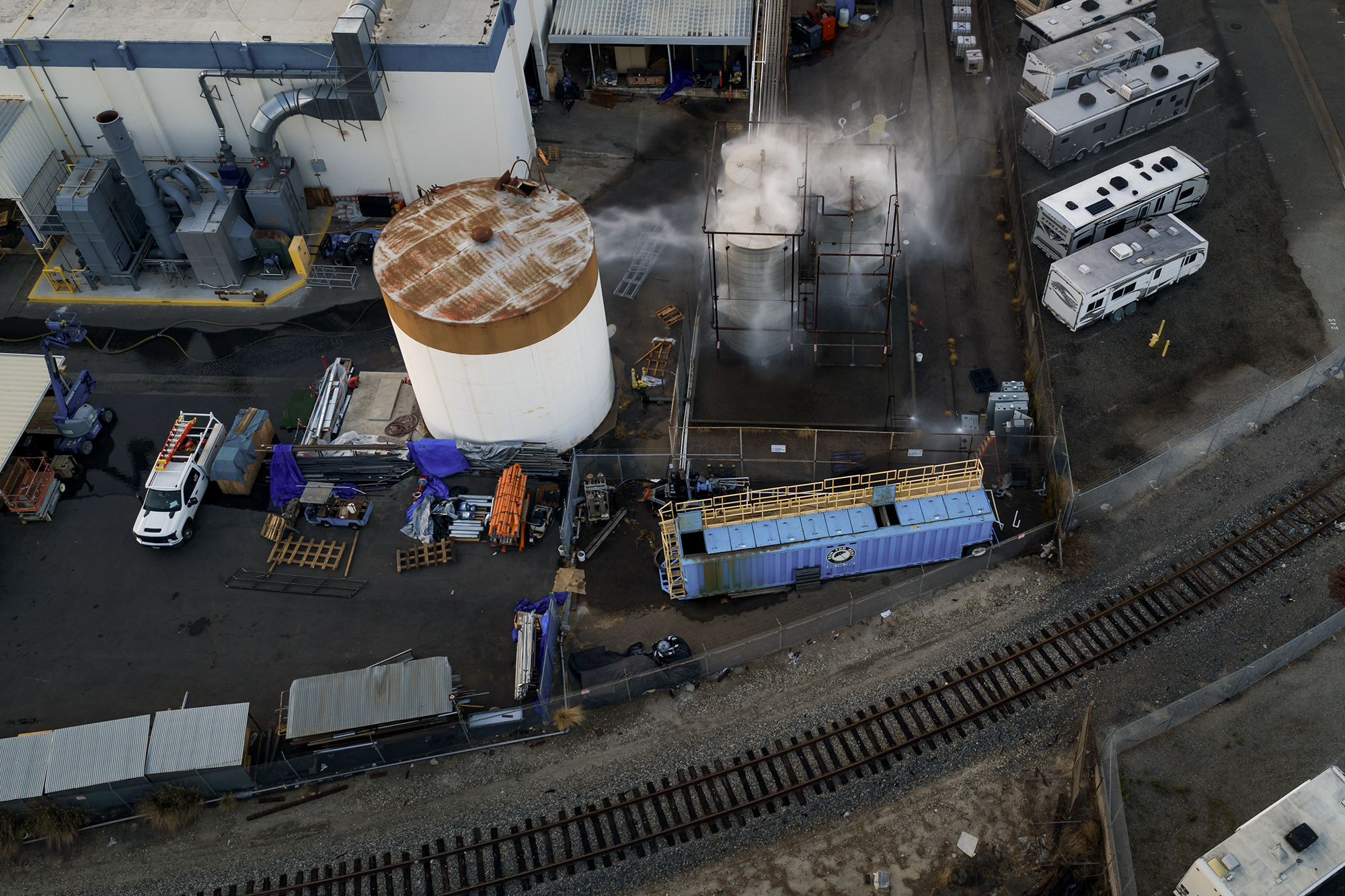
from Alejandra Reyes-VelardeCalMatters
This story was originally published by CalMatters. Subscribe to your newsletters.
This article is also available in English. Read it here.
Firefighters near an aerospace facility in Garden Grove over Memorial Day weekend faced two potentially catastrophic scenarios: either an industrial tank could explode or it could release large amounts of a toxic chemical into the air.
For many, it was the first time they had heard of the chemical, methyl methacrylate, and its possible consequences: breathing problems, nosebleeds, nausea and skin reactions that could require hospitalization.
Orange County Fire Department narrowly avoided an accident when the tank ruptures enough to release the pressure. Gov. Gavin Newsom has declared a state of emergency and several agencies are investigating what happened. However, the danger remains for some.
An analysis of federal EPA data by CalMatters found that 14 facilities stored methyl methacrylate in California in 2024. That year, four of them stored amounts similar to or greater than the amount that nearly caused a disaster near the GKN Aerospace facility in Garden Grove.
Community activists say the Garden Grove emergency illustrates how regulatory gaps and lax oversight allow dangerous chemicals to endanger life and property. thousands of people.
“This can happen anywhere,” said Ivana Castellanos, toxics program manager at Physicians for Social Responsibility in Los Angeles. “There are a lot of facilities that work with toxic chemicals … and it’s very easy for something to go wrong.”
At GKN Aerospace, methyl methacrylate is stored in a liquid state in a tank. When exposed to heat, this liquid can cause a chemical reaction called “thermal runaway,” in which the substance heats up until it becomes highly flammable and even explosive. Federal records from 2024 show the company stored between 100,000 and nearly 1 million pounds of the toxic chemical.
Several of the other companies that also reported to federal regulators that they stored the chemical have facilities near residential areas. Three facilities store much larger quantities, between 1 million and 10 million pounds each: Rohm & Haas Chemicals in Hayward, Engineered Polymer Solutions in Commerce and Plaskolite West in Compton. A fifth facility, the Arkema Coating Resins Plant in Torrance, stored quantities similar to those at GKN Aerospace.

Methyl methacrylate It is not a controlled substance neither the US Environmental Protection Agency's Risk Management Program nor California's parallel system known as CalARP. In some places, process safety rules that protect workers may cause agencies to scrutinize the chemical. Facilities may be required to have fire or other emergency plans. However, facilities that store chemicals that are not included in federal and state accident prevention programs may not be required to participate in emergency planning or community drills.
Plaskolite West, located in Compton, stores up to 20,000 pounds of methyl methacrylate in tanks and less than 2 million pounds in tankers, according to Roger Hamilton, the company's vice president of operations. During storage, the chemical is treated with an inhibitor agent to prevent leaching reaction.
Hamilton said the company reviews its internal emergency plans every year, and the incident in Orange County prompted the new review. Plans include how to respond to spills, train operators and monitor chemicals.
The company has received five notices of violation from the South Coast Air Quality Management District since 2003. In 2021, regulators fined the company for failing to comply with permit conditions for certain equipment, and in 2022, South Coast accused the company of causing a public nuisance after releasing the chemical into the air.
Hamilton testified that the second incident occurred when a plastic bag containing methyl methacrylate broke, releasing a strong odor into the air. He added that he was not aware of the previous incident.
"When you work with any kind of substrates or materials that contain hazardous substances, there is a risk," he said. "We strive to be very safety conscious when handling these materials, not only for our employees but for the communities around us, and we strive to comply with all state and federal laws."
Glynna Mayers, a Rohm & Haas Chemicals representative, said the plant currently stores less than 1 million pounds of the material and meets all applicable storage and handling requirements.
In Hayward, Myers explained, the company stores the chemical in an elevated tank surrounded by concrete and protected by a fire suppression system. Like Plaskolite West, it uses a chemical inhibitor to prevent the reaction of methyl methacrylate. The company also conducts regular drills with local emergency services, he added.
"Our priority remains the safety of our employees, neighbors and the environment," Myers said.
Dave Schrader, plant representative for Arkema Coating Resins, said the company is analyzing the lessons learned from the Garden Grove incident. He added that the Torrance plant has a strong track record of safety and compliance with environmental standards.
"Arkema and the Torrance plant are very strict when it comes to safety and environmental compliance, which is reflected in the plant's excellent performance in these areas," Schrader said. "The plant conducts emergency response drills with its own teams several times a year and with local emergency services at least once a year to ensure the site is prepared in the unlikely event of an emergency," Schrader added.
Engineered Polymer Solutions, which stores between 1 million and 10 million pounds of methyl methacrylate, did not return calls and emails from CalMatters by deadline.
The Garden Grove emergency caught environmental activists off guard in one sense: Few had heard of methyl methacrylate. But the unfolding catastrophe was a familiar story.
GKN Aerospace agreed to pay more than $900,000 to resolve a series of violations committed by the South Coast Air District under an agreement signed in 2024. The district continued to issue permits for the facility as part of its expansion plans.
"Time and time again, government agencies ... continue to allow businesses to operate with inadequate safety measures, in some cases without permits, and even to issue new permits despite decades of violations," said Bradley Angel, Greenaction's director of environmental health and justice. "It's business as usual."
All five facilities are located in communities that are among the top 50 percent of the state's most environmentally impacted communities, according to CalEnviroScreen 5.0. The Compton and Commerce facilities earned the top rating, both in the top 10 percent.
Cynthia Babich, executive director of the Del Amo Action Committee, said she has no idea of a facility that processes methyl methacrylate operating so close to residents.
Without stricter regulations and public emergency plans to deal with a disaster, she doesn't believe residents will be safe.
"When things happen like what happened in Orange County, it highlights all the fears that our community has: that people are not prepared, that we are not protected, and that there are really dangerous chemicals in our community," Babich said.
Alejandro Lazo contributed to this story.
This article was originally published on CalMatters and was republished under license Creative Commons Attribution/Attribution-Noncommercial.


