Physical Address
304 North Cardinal St.
Dorchester Center, MA 02124
Physical Address
304 North Cardinal St.
Dorchester Center, MA 02124
from Ana B. Ibarra and Alejandra Reyes-VelardeCalMatters

This story was originally published by CalMatters. Sign up for their newsletters.
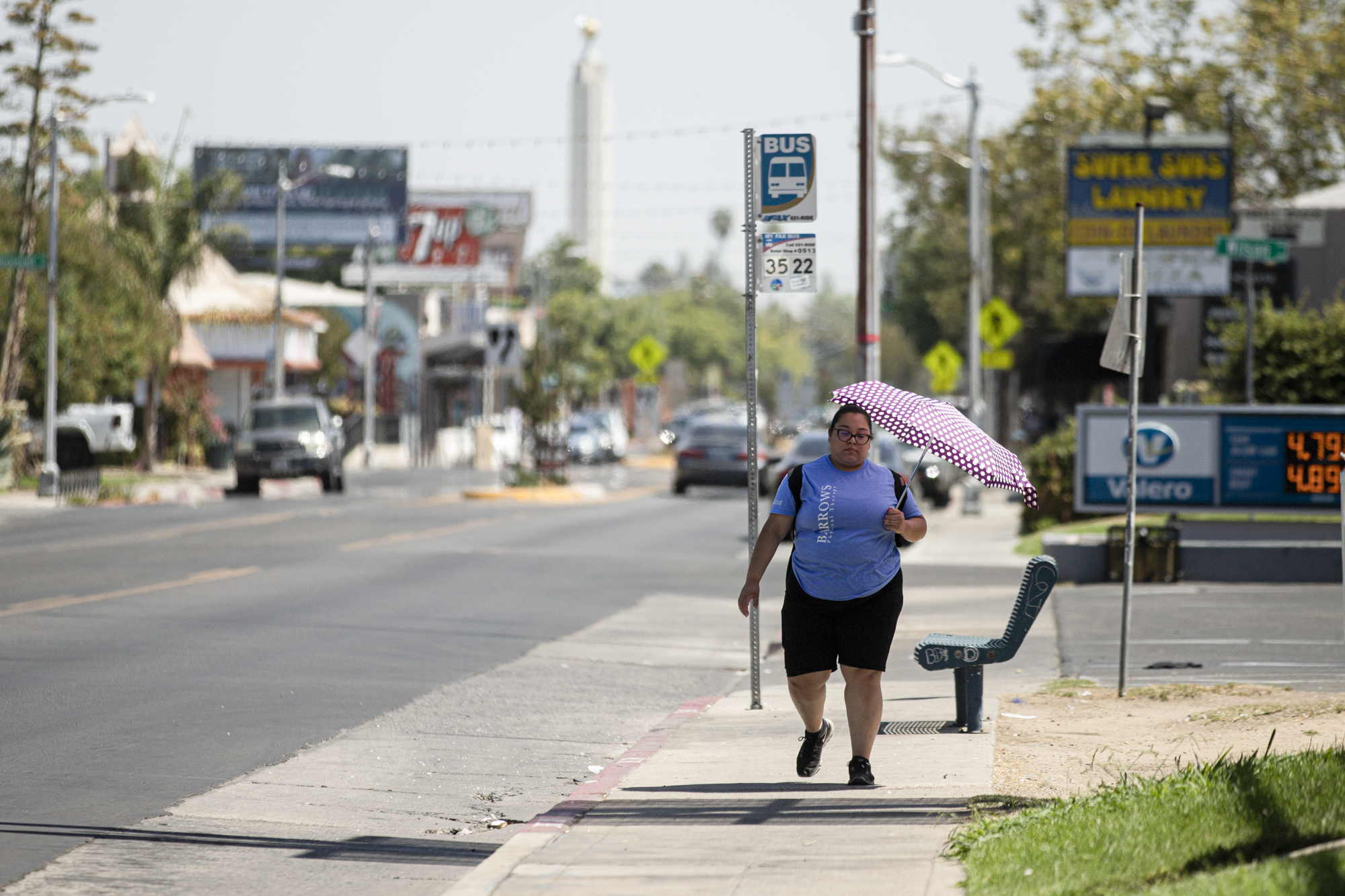
In southwest Santa Rosa, teenagers skip sports practice to avoid burns from the hot turf. Some will end up in the air-conditioned mall. In southeast Los Angeles County, people wait at unshaded bus stops, covering their faces with umbrellas and bags.
Temperatures have topped 100 degrees in some parts of the state this week — and it’s only March.
Heat doesn’t just disrupt people’s days. It is dangerous, even fatal.
California leaders have known about the danger of extreme heat for decades, and the state has spent hundreds of millions of dollars on plans to deal with it. But those plans require little or nothing from state agencies or local governments, and experts say the result is a mixed response that leaves the most vulnerable Californians behind.
The state has made real progress: more messaging and education campaigns, more data and tools to assess heat danger, and targeted grants to local communities. But without a mandate for action, which communities will be protected depends on local budgets and political will.
The state’s response remains largely organized around emergency management — mobilizing resources during crises — rather than treating heat as the ongoing public health threat that researchers say it is. As climate change leads to longer and more intense heat waves after the summer season, experts say heat must become a major part of public health work with an emphasis on prevention.
This is hard to do. Public health departments are often stretched thin—required to respond to competing emergencies, outbreaks and other surveillance work—while facing funding uncertainty.
Dr. David Eisenman, a professor at the UCLA School of Public Health, said too much heat response work is being driven by emergency management. “This is really a well-known public health emergency that needs to be addressed within public health and they need to be the main drivers on this.”
Responding to extreme heat requires coordination at multiple levels of government—bringing together state and local emergency services, planning departments, and public health. California has a state plan, and cities and counties have plans as well. But it’s not clear whether any of them matter much to people feeling the brunt of the heat.
“How we prepare for both more extreme heat and chronically higher daily temperatures is a test of how we protect health, equity and society in a warming world,” said Ali Frazzini, policy director at the Los Angeles County Office of Resilience.
The human cost of the gap is already visible. For every 100,000 inhabitants, 14.4 people visited the emergency room in 2023 for heat-related illness. The the state reported 460 deaths linked to extreme heat between 2013 and 2022, although the researchers say there were also deaths attributed to other underlying conditions that may have been exacerbated by the heat.
A condition analysis of one of the most dangerous heat waves in recent years – in September 2022 – showed a 5% increase in total deaths during that 10-day period, or 395 more deaths than expected.
Catherine Pocock, assistant physician and researcher with Healthcare in action said heat waves add another layer to the many struggles already faced without housing. During heat waves in Boyle Heights, near downtown, she made medical rounds on the streets. When he comes across people who are clearly struggling with an altered state of mind, he’ll have to figure out if it’s the result of heat or substance use.
What homeless patients need most is simple: water and ice.
“A lot of the conversations so far have been around frameworks and strategies,” Pocock said. But she wants actionable steps. “What do I need to do to be truly equipped to help support people?”
Street drug vendors say they have to raise funds privately to buy water for patients.
In 2022, Governor Gavin Newsom announced a commitment to spend $800 million to support programs that keep people safe from heat, along with the state’s comprehensive heat action plan. The state got some of that back, and much of what’s left — $351 million — is tied to a 2024 climate bond that hasn’t been fully spent.
The California Agency of Natural Resources, the Council for Strategic Growth, and the Office of Land Use and Climate Innovation distribute one-time funding to nonprofits and local governments as small one-time grants for projects that align with the state’s four goals: increasing public awareness, strengthening public services, improving indoor infrastructure, and using nature-based solutions to reduce outdoor risks.
This year, the governor proposed another $241 million in bond spending for heat programs, including $50 million for local heating action plans, $700,000 for green spaces and $55 million for community resilience centers.
The state points to tangible progress toward its heat response — updated building codes, in real time dashboard showing the vulnerability of the community and cooling centers, and a second iteration of his plan is in development.
But the limits of this progress are evident in the details. A law passed last year enshrined in state law residents’ right to a cool living space. But while the state Department of Housing and Community Development has recommended the state set a maximum indoor temperature standard of 82 degrees for all homes, the law does not require landlords to keep their tenants cool.
The state plan does not direct local governments to specific actions because each region has unique challenges. Amanda Hansen, undersecretary for climate change at the state’s natural resources agency, said that’s by design.
“I don’t think the state would ever suggest ‘this is what all local extreme heat action plans should look like or what they should contain,’ because it’s going to be really different depending on their needs and their challenges,” Hansen said.
Local organizers say they appreciate the state’s financial support, but want something more permanent. Grants the state gives out — for hydration stations, building shade structures and promoting heat safety training for outdoor workers — help, but they’re not guidelines for local governments or a statewide strategy.
“If we really want to protect our communities from the growing threat of heat, we need to come up with an integrated model,” said Enrique Huerta of Climate Resolve, a group working with Los Angeles County on one of the state-funded projects.
Counties and cities don’t just need some guidance, says Agustin Cabrera, deputy director of programs and policy for the nonprofit Strategic Concepts in Organizing and Policy Education. They need funding.
“Not all of them have enough resources to develop a heat action plan,” he said.
Local governments are ramping up heat resilience, but uncertain state and federal support limits even the most committed cities and counties.
Los Angeles County went further than most. He approved a policy requiring landlords in unincorporated areas to keep their homes at or below 82 degrees starting in 2027 — going one step further than the state. As part of your heat action plan recently published County officials are also surveying nonprofits about serving as cooling centers and helping cities develop their own cool-housing policies.
The city of Los Angeles is investigating similar policy. But his budget problems are undermining his ambitions. Mayor Karen Bass recently suggested cutting the city’s Climate Emergency Mobilization Office, led by the city’s first Chief Heat Officer, Marta Segura. Segura’s office received $750,000 from the state to develop a heat action plan. The defenders repulsed the city as well change coursebut Segura’s role was eventually moved to the city’s emergency management department.
Some communities with longer experience in managing extreme heat have developed more robust systems. Fresno makes public transportation free during heat waves, removing a barrier for residents to get to cooling centers. The county is also coordinating with social service providers to reach vulnerable clients — including people with disabilities — when temperatures soar.
Researchers say the structural problem is that no single agency owns the issue — and that’s true across the country.
In Arizona, Maricopa and Phoenix counties treat heat as a seasonal chronic health hazard, and the state has a heat officer—located in the Department of Health Services. In New Jersey, the state’s sustainability officer is tackling heat as a health issue—within its environmental department. And while the city of Miami has a heat officer, the state of Florida has banned cities and counties from establishing heat protection for workers.
In California, the State Department of Public Health collects data and offers guidance for counties and citiesbut does not provide funding for the Extreme Heat Action Plan.
Local public health departments have largely focused on managing heat crises—monitoring systems, advisories, education campaigns—rather than building long-term resilience. This is left to the land use and town planning departments.
“Very, very few public health departments are engaged in longer-term resilience and sustainability efforts,” said Kelly Turner, associate director at UCLA’s Luskin Center for Innovation. With tight budgets and competing demands unlikely to change on their own.
According to national survey to public health professionals last month, extreme heat is a growing concern – but countries are generally unprepared or under-resourced to deal with the threats. More than half of local public health associations said barriers to addressing heat included a lack of understanding of heat-related solutions, competing priorities and funding.
“It’s not like the Ministry of Heating, is it?” Turner said. “Heat has no home.”
Supported by the California Health Care Foundation (CHCF), which works to ensure that people have access to the care they need, when they need it, at a cost they can afford. Visit www.chcf.org to learn more.
This article was originally published on CalMatters and is republished under Creative Commons Attribution-NonCommercial-No Derivatives license.