Physical Address
304 North Cardinal St.
Dorchester Center, MA 02124
Physical Address
304 North Cardinal St.
Dorchester Center, MA 02124
from Alejandra Reyes-Velarde and Jeanne KuangCalMatters

This story was originally published by CalMatters. Sign up for their newsletters.
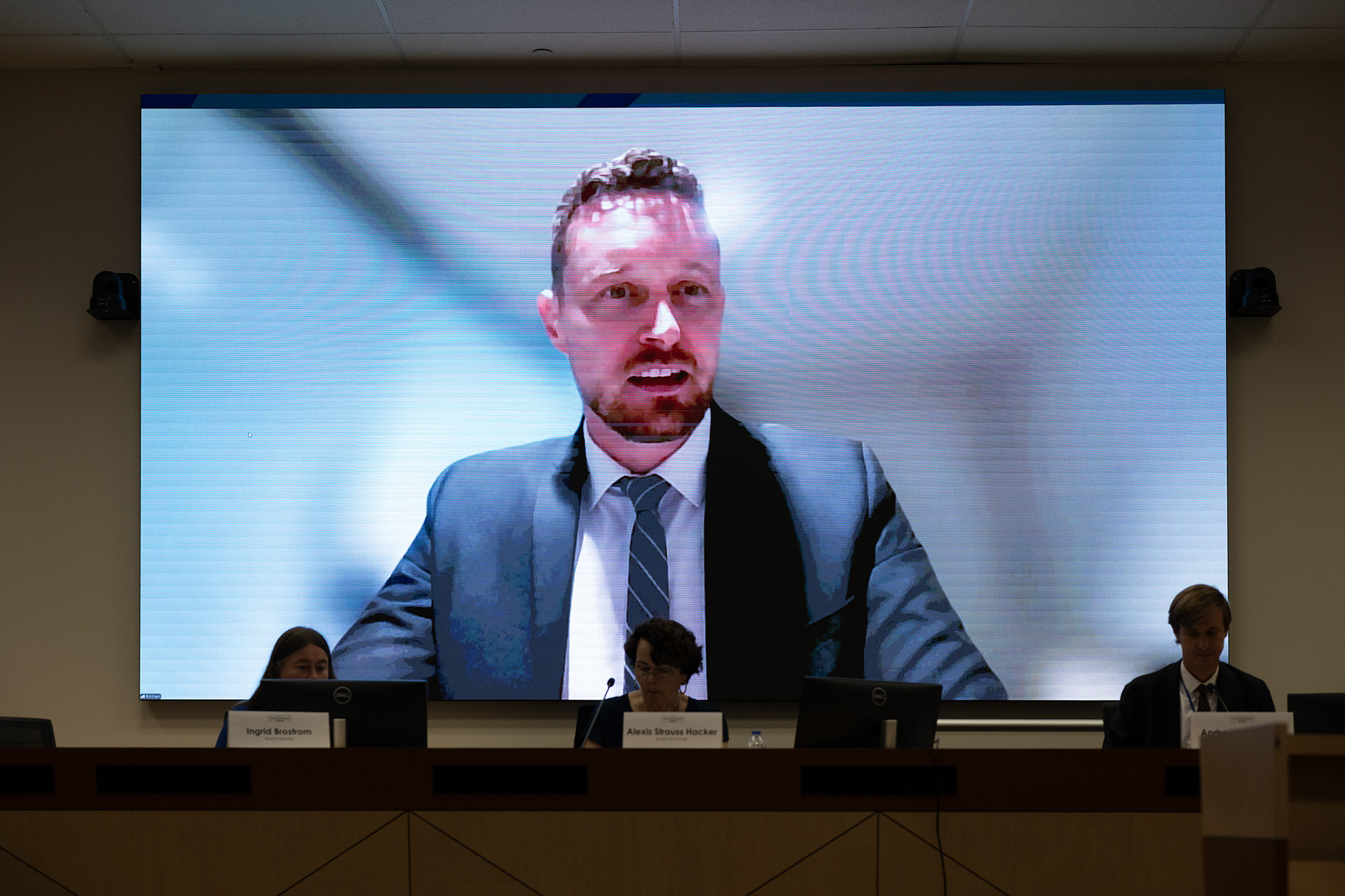
Environmental groups are calling for the resignation of the Environmental Safety Council’s newest member, Rhys Williams, over his work as a lobbyist for a firm that represents clients who handle toxic materials.
The board adjudicates complaints involving hazardous waste facilities permitted by the Division of Toxic Substances Control. Lawmakers created the board in 2021 to strengthen the department’s oversight, increase transparency and give a stronger voice to communities disproportionately burdened by hazardous waste.
Governor Gavin Newsom appointed Williams in January. Until recently, Williams was Newsom’s deputy chief of staff. In a letter addressed to Williams and copied to the board and department, environmental groups raised concerns about Williams’ work for lobbying firm Axiom Advisors. Axiom’s client list includes Clean Harbors, a hazardous waste management company, and GKN Aerospace, the company at the center of chemical accident it prompted an evacuation order for thousands of Orange County residents in May.
Williams did not immediately respond to CalMatters’ requests for comment. Williams did not comment on the letter at Thursday’s board meeting.
Williams has not been accused of any wrongdoing and his appointment was within the law, experts say.
According to the governor’s office, Williams has been thoroughly vetted and his work with Axiom is not a conflict of interest because he does not take clients with questions before the board. Williams also agreed to recuse himself from matters related to Axiom clients.
“Rhys Williams is a highly qualified public servant with years of experience helping California address some of its most complex infrastructure, emergency management and environmental challenges,” Newsom spokesman Anthony Martinez said in an email. “His appointment reflects his deep domain expertise, professionalism and longstanding commitment to public service.”
Advocates say his work for the lobbying firm undermines public confidence that he can act impartially to protect communities from environmental damage.
Environmental groups “were alarmed just by the audacity to appoint someone who is or has been tied to the toxic waste industry,” said Bradley Angel, executive director of Greenaction for Health and Environmental Justice. “This does not bode well for impartiality or for upholding the Environmental Safety Board’s stated mission of protecting the public from toxic substances and promoting environmental safety, not promoting the profits of polluters.”
According to Williams’ LinkedIn profile and Secretary of State lobbying disclosures Cal-access website, Axiom Advisors hired Williams in May, four months after he was appointed to the board.
Axiom Advisors announced LinkedIn’s June hiring. “This appointment brings something very important to Axiom’s customers,” the post said. “Rhys’ extensive experience with agencies that can move projects forward is invaluable to companies looking to do business here.”
The firm’s client list includes GKN Aerospace, which uses the dangerous chemical methyl methacrylate for making cockpit canopies, passenger windows and other transparent aerospace materials; Clean Harbors, a company that oversees one of the state’s two hazardous waste landfills, and the California Construction Industry Association, an advocacy group for developers and homebuilders.
As a lobbyist with Axiom, Williams has attended meetings between GKN and the legislative staff of Sen. Tom Umberg, an Orange County Democrat, who is leading a proposal to hold the company accountable and offer relief to residents, according to a source familiar with the talks. The Department of Toxic Substances Control does not primarily regulate GKN, an aerospace manufacturer, although it may have an oversight role if the company temporarily stores or transports hazardous waste.
Williams began working for Newsom as chief of staff in the lieutenant governor’s office in 2014 and has held various roles advising Newsom on infrastructure and emergency preparedness since becoming governor in 2019.
Williams earned nearly $200,000 as deputy chief of staff in the governor’s office until January 2026, when he left for a board appointment, a part-time role paying $93,135. The governor also later appointed Williams to a position on the Board of Forestry and Fire Protection, which comes at $100 a day.
Asked in January why Williams was leaving the governor’s office, spokeswoman Izzy Gordon said the aide had “earned his freedom :)” after more than a decade working for Newsom.
Williams joined the five-member board, which after five years had already faced sharp criticism for its questionable oversight of polluting facilities. In the coming months, the board will vote on several appeals related to permits and permit modifications for some of the state’s largest hazardous waste facilities.

The creation of the board followed decades of complaints from communities and environmental advocates who criticized the Department of Toxic Substances Control for delaying facility permits and for failing to protect communities from environmental damage.
The department’s handling of the decades-long Exide lead-acid battery disaster in Los Angeles was one incident that led to reforms. Regulators found that Exide Technologies had been contaminating soil with lead and arsenic near thousands of homes for decades. The battery recycling plant has operated only with a temporary permit for more than 30 years. State officials documented more than 100 violations at the plant and continued to allow it to operate.
In 2015, as part of an earlier bankruptcy, Exide agreed to permanently close the Vernon plant and pay $50 million for a cleanup. The company filed for bankruptcy again in 2020, and a federal judge approved a settlement allowing the company to leave the site entirely — despite the objections of state officials — transferring responsibility for the ongoing cleanup to the state.
Critics say the department’s slow permitting processes and its pattern of issuing permits for facilities with a history of violations continue.
Phibro-Tech and Ecobat are not Axiom customers.
“BES was supposed to be our firewall to protect communities,” said Matt Holmes, co-coordinator of the California Coalition for Environmental Justice, referring to the Environmental Safety Board.
Holmes added that while the board has improved dialogue with communities, “we were disappointed that (the board) really wasn’t the firewall for toxic communities to get equal treatment from the state.” The letter asking for Williams’ resignation, he said, “is a matter of, we need to be clear about what we expect (the board) to be.”
Legal experts said it is neither illegal nor unusual for state board members to also work as lobbyists. But they can run into trouble if they advocate for companies for which they manage and serve as board members.
There is no evidence that Williams violated specific conflict-of-interest laws: GKN Aerospace does not hold permits to handle or store hazardous waste controlled by the DTSC, and it is not clear that he has any connection to Clean Harbors or other Axiom clients that environmental groups have raised questions about.
Still, Williams could run afoul of the broader common law conflict of interest statute, said Frank Zerunyan, a professor of government ethics at USC.
“Does the fact that this person lobbies for a particular interest make the people of California, who are likely counting on this person to be an objective commissioner or board member for the purpose for which he was appointed, less confidence in California or less confidence in this organization?” he said. “That’s the point.”
It doesn’t matter to environmental groups whether Williams ever votes for Clean Ports, GKN or other Axiom clients. They argue that the association alone is enough to undermine public confidence in its ability to adjudicate appeals fairly.
“During your tenure on the Board, the public may question whether your statements and activities (or lack thereof) may be knowingly or unknowingly influenced by the interests of Axiom’s current clients, as well as the interests of potential clients Axiom may hope to attract,” the groups wrote in their letter to Williams.
Williams is one of more than a dozen senior Newsom staffers or close political operatives the governor has appointed to paid and unpaid positions on California’s vast collection of state boards and commissions.
Such appointments are common, especially as governors prepare to leave office, and are known as convenient landing spots for legislative staffers and political aides looking to leave full-time government service. They also give the governor lasting influence over policy decisions and important issues.
“It’s a time-honored tradition for California governors to appoint high-ranking officials to multiple positions as a ‘reward’ for high-pressure, round-the-clock administration jobs,” said Sacramento Democratic consultant Steve Maviglio, who in 2003 received such an appointment to the Unemployment Insurance Appeals Board from outgoing Gov. Gray Davis.
Mavilio, Davis’ press secretary, spoke in general terms, saying that it makes sense for governors to appoint officials who are “loyal and battle-tested,” but that sometimes “appointments are made for the sake of qualifying for retirement benefits.” Davis’ successor, Gov. Arnold Schwarzenegger, promised to overhaul the boards and commissions, but later appointed several of his staff to them.
This article was originally published on CalMatters and is republished under Creative Commons Attribution-NonCommercial-No Derivatives license.


