Physical Address
304 North Cardinal St.
Dorchester Center, MA 02124
Physical Address
304 North Cardinal St.
Dorchester Center, MA 02124
from Ryan Sabalow, Jeanne Kuang, Nadia Lathan and Yue Stella YuCalMatters
This story was originally published by CalMatters. Sign up for their newsletters.
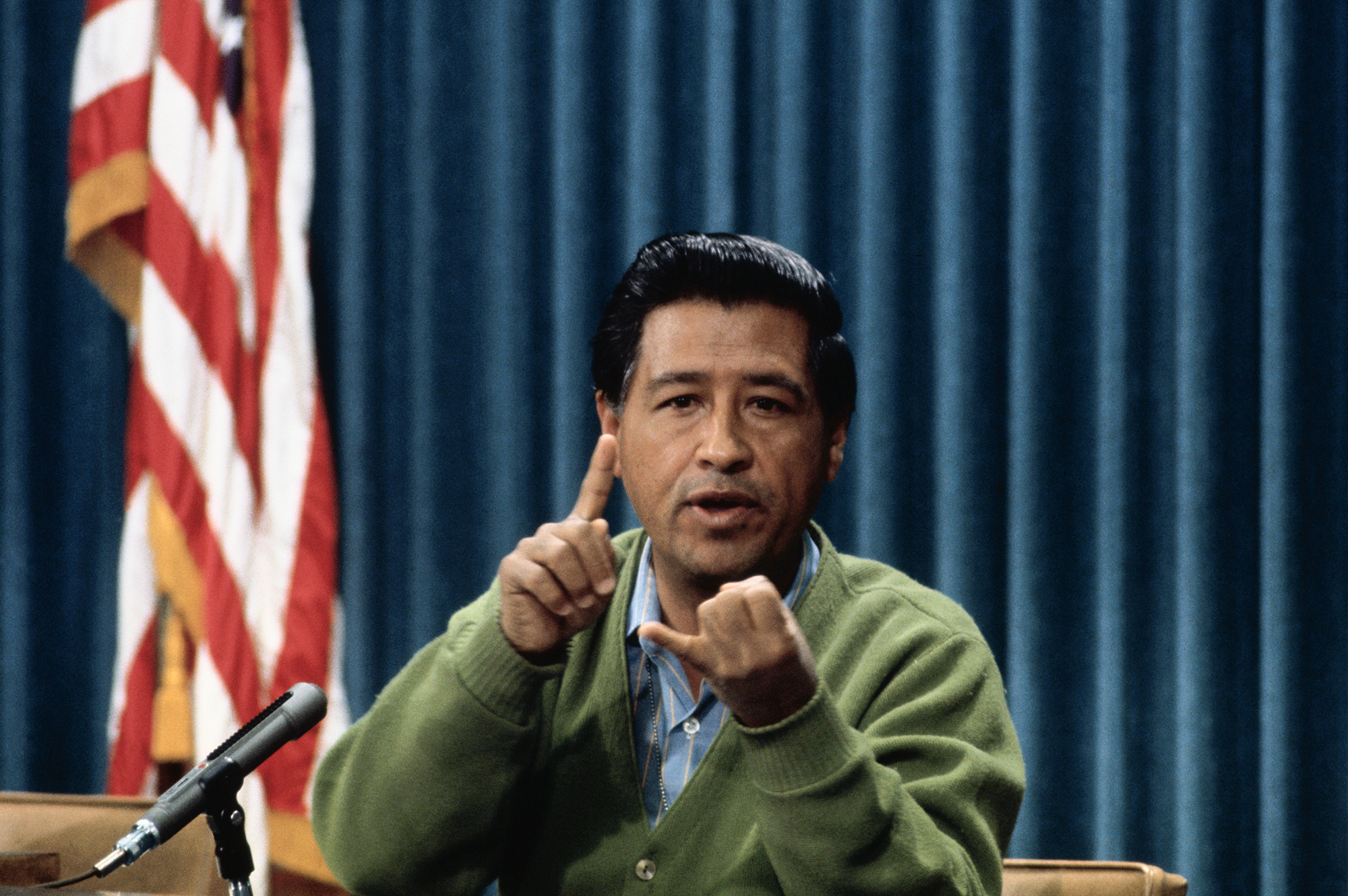
Cesar Chavez, the legendary California farm labor activist and Mexican-American civil rights icon, has been a figure intertwined with state and national Democratic politics for decades.
Former President Joe Biden had a bust of Chavez in the White House. Gov. Gavin Newsom told reporters that the black-and-white photograph of Chavez and his close ally Senator Robert Kennedy is the first picture he sees in his home every morning.
And in California, Chavez’s name is intertwined with everyday life. Dozens, if not hundreds, of public schools, boulevards, community centers and city squares bear his name. It is even part of the California schools formal curriculum.
Now, less than two weeks before California celebrates the late labor leader’s birthday with a state holiday, state and national Democrats are grappling with the shocking revelation that scores of women have come forward alleging Chavez raped them. One of those women was his partner in the movement, Dolores Huerta.
on Wednesday, The New York Times published investigation naming three women who accused Chavez of using his position of power to sexually assault them. Two were daughters of union leaders. They told the Times they were abused as girls.
The other was Huerta, herself a labor icon who co-founded the farmworkers union with Chávez, popularized the call “Sí, se puede” and who remains a towering figure in Democratic politics. Huerta said in the Times story that Chavez raped her and that she gave birth to two children after dating him.
“Unfortunately, he used some of his great leadership to abuse women and children — it’s really horrible,” Huerta, 95, told the Times.

The fallout from the revelations was immediate, as Democratic politicians and labor activists scrambled to react as one of their heroes was forever tarnished.
“How many days I’ve marched, how many times I’ve been with students talking about the movement, how many pictures I have in my home of Bobby Kennedy and Cesar Chavez,” Newsom told reporters at a news conference. “That was hard to take.”
His wife, Jennifer Seibel Newsom, a survivor of sexual abuse and director of several films about gender equality, told reporters through tears that she was “a little shaken for Dolores and these young women.”
“Women are in our hearts,” she said in Spanish.
The United Farm Workers, the union Chavez founded, called the allegations “indefensible” and canceled its Cesar Chavez Day events. Just four years ago, the union recreated his iconic March to Sacramento as he got Newsom to sign a law designed to facilitate member registration.
Meanwhile, other state political leaders, members of Congress and Democratic gubernatorial candidates issued statements condemning the allegations and showing support for the women who spoke out.
“For survivors and their families, the weight of their pain is real and ongoing,” Assembly Democratic spokesman Robert Rivas it said in a statement that did not name Chavez. “The farmworker movement has never been about one person; it is bigger than any one person, and its values of dignity and justice are more important now than ever. To those who have found the courage to come forward, my heart goes out to you.”
Rivas, like many California Democrats serving in the legislature, has close ties to the labor movement and is a former union member.
Rivas grew up in farmworker housing and has long made Chávez part of his political history. In 2024he was honored by the Cesar Chavez Foundation along with Jane Fonda.
Rivas’ office did not respond to CalMatters when asked if the Legislature would fast-track legislation to rename the state holiday in time for March 31. The Legislature made it a public holiday in 2000. To change the name, the Legislature would have to pass a bill that Newsom would have to sign into law.
Newsom told reporters he was open to the idea, but leaders needed some time to absorb the shock.
“We need to unpack all of this, first dive a little deeper to understand before we move on to the next steps,” he said. “There is a sense of urgency in the context of this being the month we celebrate the life and times of a figure we have long embraced and revered.”
The Legislature’s Latino caucus is also debating what to do, a Los Angeles Democratic Assembly member said Mark Gonzalez.
“All options are being carefully considered in response to allegations of sexual abuse involving Cesar Chavez, including the possibility of renaming the public holiday,” he said in a statement. “This is a moment that requires care, accountability and a commitment to support survivors of sexual abuse.”
At the same time, local leaders were also considering removing Chavez’s name from their landmarks.
San Diego officials may rename César Chávez Parkway, according to spokesman Dave Roland.
“The allegations of abuse against Cesar Chavez are shocking and disturbing,” Mayor Todd Gloria, a Democrat, said in a statement. “Our first concern must be for the survivors who have come forward and those who have not.”
The city, which is the second most populous in the state, has a park and avenue named after the civil rights leader.
In Sacramento, where César Chávez Plaza sits just a few blocks from the Capitol, leaders are also taking steps to rename the landmark.

Mayor Kevin McCarthy, a former Democratic lawmaker who says he has participated in UFW and Chavez Day marches for 30 years, was convening a subcommittee to work on the name change.
“We take these allegations seriously and will ensure that the naming of our city facilities is consistent with our values,” he said in a statement.
For many Democrats, Chávez was more than a historical figure—he embodied the party’s ideals of labor, justice, and social change. He was also a revered leader in Latino communities, many of whom remembered him for his decades-long struggle for the rights of farmworkers.
“Certainly no one can deny that Cesar Chavez is an incredibly influential figure, not only on the California landscape, but nationally,” said Mindy Romero, founder and director of the Center for Inclusive Democracy, which studies Latin American politics.
From rallies to protests to podiums, California Democrats often invoke his name. Lawmakers have mentioned Chavez at least 278 times in hearings since 2023, according to CalMatters Digital Democracy Database.
“We’ll often see the reference to Cesar Chavez … as almost proof that they stand in solidarity with the labor movement and the Latino community,” Romero said.
Last year’s legislative sessions in honor of Cesar Chavez Day included one after another of lawmakers praising Chavez and what he stands for.

“There are so many communities in California that have schools and health clinics and major boulevards and thoroughfares named after Cesar Chavez and all that legacy, and they’re a recognition of that past. Those roads are the roads to somewhere,” the West Sacramento Democratic senator. Christopher Cabaldon he told his colleagues at that time. “They are the avenues that we must continue to push, to continue to fight, especially now, to make that dream a reality. Because not every farmworker in California has achieved the dreams that Cesar and everyone else mentioned on this floor have aspired to.”
But the importance of Chavez’s legacy is precisely why the allegations are hard for Democrats and unions to swallow, said Christian Dioghi Phillips, a former policy director at the Service Employees International Union and now an associate professor of political science and international affairs at the University of Southern California.
“As organizers, we’re always trying to understand power and figure out how we can distribute it more fairly and make sure people have a voice,” she said. “And this whole dynamic is wrapped up in this story that’s unfolding, and how power is being abused, how people don’t have a voice. As organizers, I think there’s nothing worse than that.”
Romero said the scandal could hinder Latino representation in California politics. Few Latin American leaders have received as much recognition as Chavez: then-President Bill Clinton awarded him the Presidential Medal of Freedom in 1994.
“You have the loss of a hero, but you also have just recognition of our community that will be called into question,” she said.
“People will now struggle to reconcile this new, horrific element of his story,” she added. “Do people still celebrate him? How do they recognize his influence on this new story?”
For some Democrats, the charges were shocking beyond what Chávez represented for their movement.
Some had personal ties to Chávez’s alleged victims.
California’s Democratic senator Eloise Gomez Reyes of San Bernardino calls Huerta a “dear friend.” In a statement, she said she felt a mixture of “fury, grief and disappointment” after learning what Huerta and the other women had told The Times.
“These revelations are deeply painful,” Reyes said. “They demand that we seek accountability through due process under the law — and face a deeply uncomfortable truth: We must never hold anyone accountable.”
Huerta addressed lawmakers at least five times from 2024, according to Digital Democracy.
But the charges also provide politicians with an opportunity to lift up women who have been subject to power dynamics and recognize other Latino leaders who have contributed to the labor movement for decades, political scientists say. Removing Chavez’s name from schools and road signs, Phillips said, is “basic and obvious.”
“To truly honor the movement of which this man’s name was such an important symbol, our elected officials must do much more,” she said. “There’s also work for our community leaders … to reach beyond the loudest, most charismatic person in the room in communities and find out who’s really doing the work.”
Digital Democracy’s Foaad Khosmood, Forbes Professor of Computer Engineering at Cal Poly San Luis Obispo, contributed to this story.
This article was originally published on CalMatters and is republished under Creative Commons Attribution-NonCommercial-No Derivatives license.