Physical Address
304 North Cardinal St.
Dorchester Center, MA 02124
Physical Address
304 North Cardinal St.
Dorchester Center, MA 02124
from Adam EchelmanCalMatters

This story was originally published by CalMatters. Sign up for their newsletters.
Federal financial aid is the engine of the nation’s higher education system, pouring billions into student loans and grants in California alone, and this summer the U.S. Department of Education plans to expand aid to students enrolled in short-term work-study programs.
Except the state is not ready.
Launching a new financial aid program means creating new systems at the state and local levels, and the California Student Aid Commission, the state agency in charge, has said it needs more help. Although the federal aid program is scheduled to begin as soon as July 1, Daisy Gonzalez, the aid commission’s executive director, has said repeatedly, both in state hearings and in an interview with CalMatters, that the money won’t be available to students until weeks or even months later.
Financial aid systems are “extremely complex”, she said, and the state lacks the infrastructure to build one on the federal government’s schedule.
The new financial aid awards, known as short-term or workforce Pell grants, are an expansion of the federal Pell Grant program, which for decades has offered thousands of dollars in cash to low-income students for tuition and living expenses.
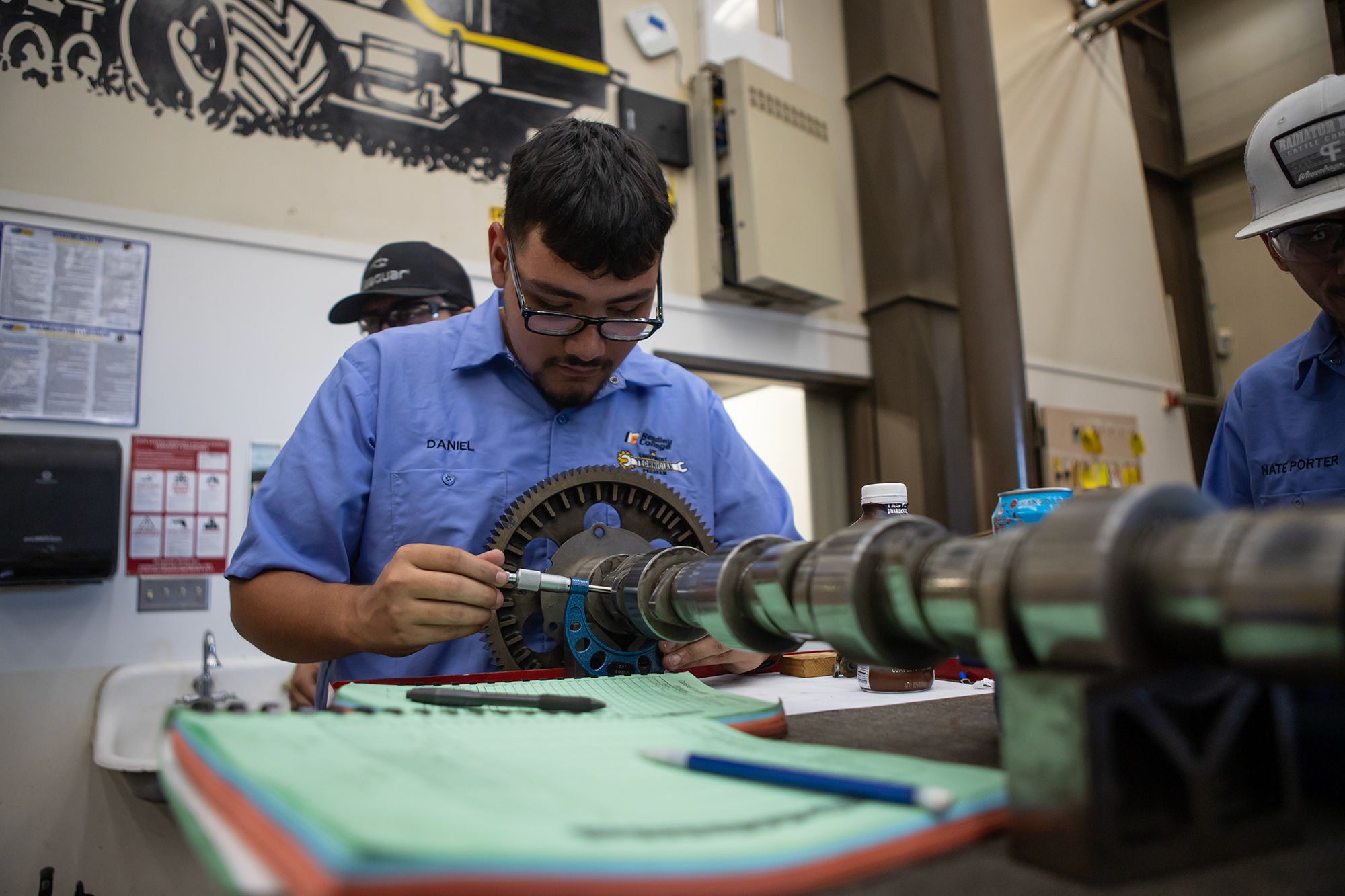
Historically, students in short-term work-study programs have not been eligible for federal student aid. The new Pell grants will give money to students who enroll in programs such as auto mechanics or information technology, most lasting about 10 weeks. Both public and private institutions are eligible, and the average student is expected to receive between $1,000 and $3,000, though details have not been finalized.
The new grants are part of a national, bipartisan effort to further align higher education with the needs of employers, but the results have sometimes been lacking.
In 2024, CalMatters examined how California job centers use federal money to help low-income and unemployed adults attend short-term job training programs at for-profit colleges. Thousands of dollars in public grants have gone to these schools to train truck drivers and nursing assistants — careers that have a reputation for low wages, poor working conditions or high turnover.
Some of these for-profit schools were under investigation for various student enrollment violations. CalMatters found that most truck driving schools have virtually no supervision. Some assistant nurses did less than $30,000 after graduation.
The new Pell grants for short-term job training programs come with federal regulations intended to ensure that graduates earn above-poverty wages in in-demand careers and that only certain types of vetted schools will be eligible. California is considering state legislation that would further limit the types of programs that can qualify.
Because neither the state nor the federal government strictly monitors these short-term vocational training programs, it is unclear how many exist and how many students could ultimately benefit. Experts say California college students could be among the primary recipients, as the state’s 116 colleges already offer numerous short-term degree programs in skilled trades, health care, technology and public safety. But in an email to CalMatters, the chancellor of California Colleges said it was too early to provide any estimates.
As an approximation, Gonzalez points to CalGrant C, which provides state funding to students in vocational training programs that last at least 15 weeks. This year more or less 225,000 students are potentially eligible. But unlike the new Pell grants, which could lead to billions in federal spending, CalGrant C has a relatively small budget, serving just under 7,800 students a year.
In south San Diego County, many community college students work full-time but still can’t afford the cost of living, said Mark Sanchez, president of Southwestern College in Chula Vista. Many students — including U.S. citizens — are “transitional,” he said, meaning they live in Tijuana, where housing is cheaper, and cross the U.S. border for school every day because they can’t afford to live in California.
Sanchez advocated for the new Pell grants, telling state and local officials that they could create a path for his students to get higher-paying jobs. His team estimated that roughly 1,500 students could qualify for scholarships in about 50 different programs, ranging from music sciences to accounting.
In order for students to qualify, schools will have to work over time with the state and federal governments to prove that at least 70 percent of those who graduate from these vocational programs are employed and that their wages are above the federal poverty line. The data is scattered and hard to track, and in some cases the information isn’t collected at all, said Su Jin-Jez, CEO of California Competes, an education nonprofit.
State data can tell you, for example, that a college graduate works for a school district and how much they earn, but the data can’t tell you what they do at the school, such as whether they’re a teacher, secretary, lawyer or janitor, Jez said. “Our state is investing billions in aligning higher education and the workforce, and we have no good way of knowing whether those investments are paying off.”
California Competes sponsored two bills in the legislature this year, including one by Sen. Christopher CabaldonDemocrat from Napa, which would require state workforce agencies to collect more data. The other is from an MP Jackie IrwinDemocrat from Thousand Oaks, and would regulate which programs can qualify for the new short-term Pell grants. On the last bill, deputy Juan AlanisRepublican of Modesto, is a co-author and the Institute for College Access and Success is a co-sponsor.
Separately, the governor’s office has written emergency legislation that contains proposed regulations for the new Pell grants. Although the California Student Aid Commission cannot take a position on the bills, Gonzalez has openly praised Irwin’s bill and criticized the governor’s proposal, saying it “risks creating a fragmented system.”
During the COVID-19 pandemic, Governor Gavin Newsom and the Legislature created a new financial aid program known as the Study-Based Employment Program, which was supposed to provide millions in financial aid to working students to help them secure jobs related to their degree program.
The program was a failure, said Gonzalez, who was vice chancellor of the community college system at the time. There was only one-time funding and a three-year window for success, she said. “What was sorely lacking … was professional development and technical assistance. You can’t just introduce a new tool and then say, ‘Students apply.'”
By the end of the three-year window, few students had applied, and state lawmakers decided to cut the program. In a statement emailed to CalMatters, Nicole Kangas, a spokeswoman for the student aid commission, said the tuition-matched employment program is a warning about the new Pell grants.
Expanded Pell grants were approved last summer, but the U.S. Department of Education only finalized its regulations last month, giving states less than two months to roll it out before the July 1 start date. California officials and colleges now have a long list of regulatory and administrative tasks to complete, including creating special agreements between the state and each of its college districts and universities. When the California Student Aid Commission created similar agreements with universities for Middle Class Scholarshipthe contracts are between 60 and 120 pages long and took about nine months to finalize, Gonzalez said.
“We’re really behind,” she said, adding that many other states have already passed legislation. Some new regulations, like Irwin’s bill, could give the state “an opportunity to catch up,” she said.
For Sanchez, the challenge is not just administrative. With the new Pell grants available, he said, Southwestern College still needs to inform current and potential students that these grants exist and convince them to apply.
Although the majority of community college students experience financial hardship — including some who are homeless — many are unaware of financial aid, hesitate to apply, or submit incomplete applications. Less than half of all community college students attached for financial aid last year and government data shows that even fewer got it in the end.
This article was originally published on CalMatters and is republished under Creative Commons Attribution-NonCommercial-No Derivatives license.


