Physical Address
304 North Cardinal St.
Dorchester Center, MA 02124
Physical Address
304 North Cardinal St.
Dorchester Center, MA 02124
from Deborah BrennanCalMatters

This story was originally published by CalMatters. Sign up for their newsletters.
As Tijuana River sewage polluted neighborhoods in southern San Diego County, the federal government pledged two-thirds of a billion to clean them up.
Local lawmakers are now calling on California to step up its fight against transboundary pollution, and this week one introduced a bill to revise air quality standards for noxious gas from the river.
State Sen. Catherine Blakespear held a joint hearing of the Senate Environmental Quality Committee and the Assembly Environmental Safety and Toxic Materials Committee in San Diego Thursday to explore how the state can help solve the problem.
“California has long been a national leader in environmental protection and policymaking,” Blakespear said during the hearing. “But what’s happening in the Tijuana River Valley is an international environmental disaster that is undermining everything that California stands for.”
The hearing at the Scripps Institution of Oceanography in La Jolla brought together scientists and civic leaders to discuss how failing infrastructure, industrial waste and decades of neglect created the ecological disaster and what it will take to fix it.
“Because of its international nature, we know the federal government has to take the initiative,” Blakespear said. “Still, there’s a lot that state and local governments can do.”
After decades of stagnation, action against Tijuana River pollution is accelerating. The US Environmental Protection Agency announced on Monday a a new agreement with Mexico for wastewater infrastructure planning to accommodate future population growth in Tijuana.
On Wednesday, state Sen. Steve Padilla introduced a bill to update the state’s standards for hydrogen sulfide, a noxious, rotten-egg-smelling gas that is produced by sewage in the river. Residents of the area complain of headaches, nausea and other ailments when hydrogen sulfide reaches high concentrations. The bill would require the California Air Resources Board to review the half-century-old standard and tighten it if necessary.
State lawmakers are also seeking to improve conditions for lifeguards and other workers exposed to pollution and to hold American companies accountable for their role in polluting the river. County officials will conduct an extensive health study to measure the effects of pollution on the Tijuana River and are making plans to eliminate a pollution hot spot in Imperial Beach.
Sewage spills in southern San Diego County became commonplace in the early 2000s, causing nausea to swimmers and surfers at local beaches. Then, aging sewage plants failed, sending hundreds of millions of gallons of raw sewage into the ocean. Last year, Scripps researchers found that the river was harming nearby communities by releasing chemicals into the air, including hydrogen sulfide gas that smells like rotten eggs.
“Sewage flowing into San Diego County’s coastline is poisoning our air and water, harming public health, closing beaches and killing marine life,” Blakespear said.
San Diego officials successfully lobbied for federal investment to upgrade aging wastewater treatment plants. They also instituted faster water quality testing and surveyed residents to understand health concerns.
Paula Stigler Granados, a professor of public health at San Diego State University, said surveys of people living near the Tijuana River found “scarier things,” with 45 percent experiencing health problems, 63 percent saying pollution interfered with their work or school and 94 percent of respondents reporting sewage odors at home.
“Kids wake up sick in the middle of the night,” she said. “It’s ongoing, chronic exposure, not a one-time event.”

Water samples revealed industrial chemicals, methamphetamine, fentanyl, restricted pesticides, pharmaceuticals and odor-causing sulfur compounds, she said.
“This is an absolute public health emergency,” Stigler Granados said. “I really think this is the biggest environmental crisis we have in the country right now.”
This sense of urgency is not universal. Last year, Gov. Gavin Newsom rejected requests from San Diego officials to declared a state of emergency on the pollution problem at the border, saying it “wouldn’t mean anything.”
Over the past two years, state Sen. Steve Padilla has introduced legislation to fund wastewater treatment improvements, limit construction of landfills in the Tijuana River Valley and require California companies to report waste discharges that affect the state’s water quality, but those bills have failed. He said the problem is being overlooked in this border area with low-income and working-class populations.
“This is one of the most unique and acute environmental crises in all of North America,” Padilla said. “It’s underrated just because of where it’s happening.”
This year, the US repaired the damaged South Bay International Wastewater Treatment Plant and expanded its capacity from 25 million to 35 million gallons of wastewater per day. In April, Mexico repaired its Punta Bandera plant near the border, reducing the flow of wastewater into the ocean.
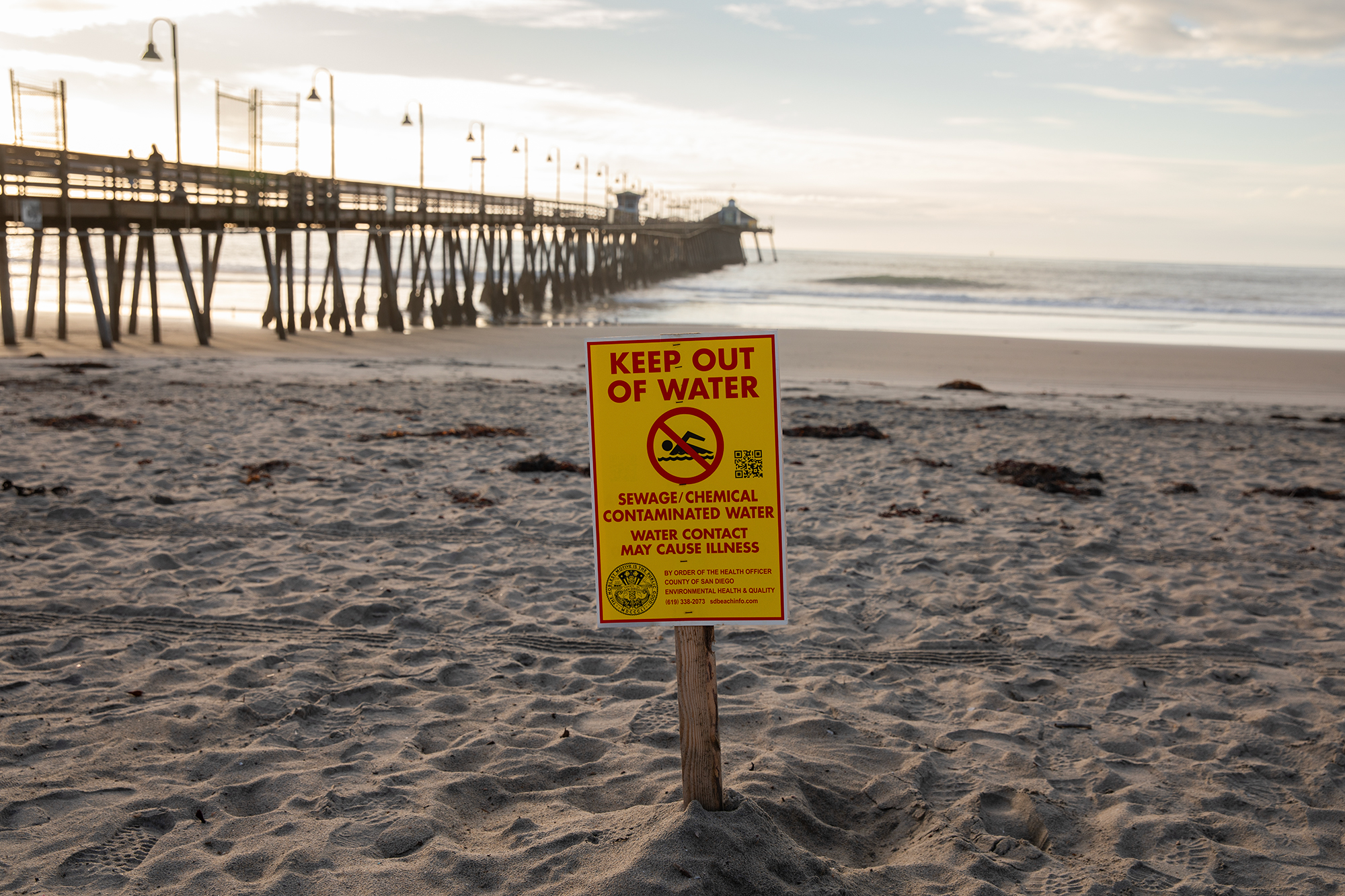
But Imperial Beach’s shoreline has remained closed for three years, and residents still complain of headaches, nausea, eye irritation and respiratory ailments from airborne pollution. This problem is worst at a point known as Saturn blvd hot spot in Imperial Beach, where flood control culverts churn sewage-polluted water into foam, spewing pollutants into the air.
“When the water is polluted, you can close the beach,” said Kim Prater, an atmospheric chemist at Scripps who identifies toxins in the air. “But you can’t tell people not to breathe.”
Community members feel forgotten by state leaders as they face chronic air pollution and years of beach closures due to contaminated sewage from the Tijuana River, said Serge Dedina, executive director of the environmental organization WildCoast and former mayor of Imperial Beach.
“They’re saying, ‘Why doesn’t California care about us?’” Dedina said.
As federal officials plan to expand the International Wastewater Treatment Plant in South Bay, which will increase its capacity to 50 million gallons per day, local and state leaders have their own plan of action.
A top priority for Aguirre is removing the culverts on Saturn Boulevard. hotspots that cause air pollution.
“This is a low score that we should not depend on the federal government to fix,” Aguirre said.
She hopes to get funding for that project from Proposition 4, the state environmental bond that voters passed earlier this year. He dedicates 50 million dollars to cleaning up degraded waterwaysincluding the Tijuana River and the Nova River, which flows into the Salton Sea.
The county is also planning a health study that will include physiological measurements to determine the health effects of Tijuana River pollution.
“What we’re working on is how we’re going to take real, hard medical data and follow a cohort of people who live in this environment so we can understand what’s going on in their bodies,” Aguirre said. “What happens to children and adults? What is in their blood?”
San Diego County has distributed about 10,000 home air purifiers to households near the Tijuana River, but Aguirre wants to provide devices to all 40,000 homes in the affected area.
Dedina said his organization removes waste tires that are exported to Mexico and washed back into the Tijuana River Valley.
“My lesson is that we have to stop the sludge, the tires, the trash, the toxic waste, the sewage,” he said.
In addition to his bill to update hydrogen sulfide standards, Padilla said he is exploring legislation to regulate pollution created by California companies operating through maquiladoras in Mexico. He wants to work with Mexico “to put pressure on them to basically push American companies that are licensed to do business here in California.
Blakespear said he wants to protect lifeguards and other public workers exposed to pollution.
Whether the solution is creating environmental standards for international business or funding expensive infrastructure, lawmakers recognize that the binational nature of the problem makes it difficult to solve.
“The complexity of this being an international issue and this being a federal issue added to the difficulty of who should act,” Blakespear said.
This article was originally published on CalMatters and is republished under Creative Commons Attribution-NonCommercial-No Derivatives license.

