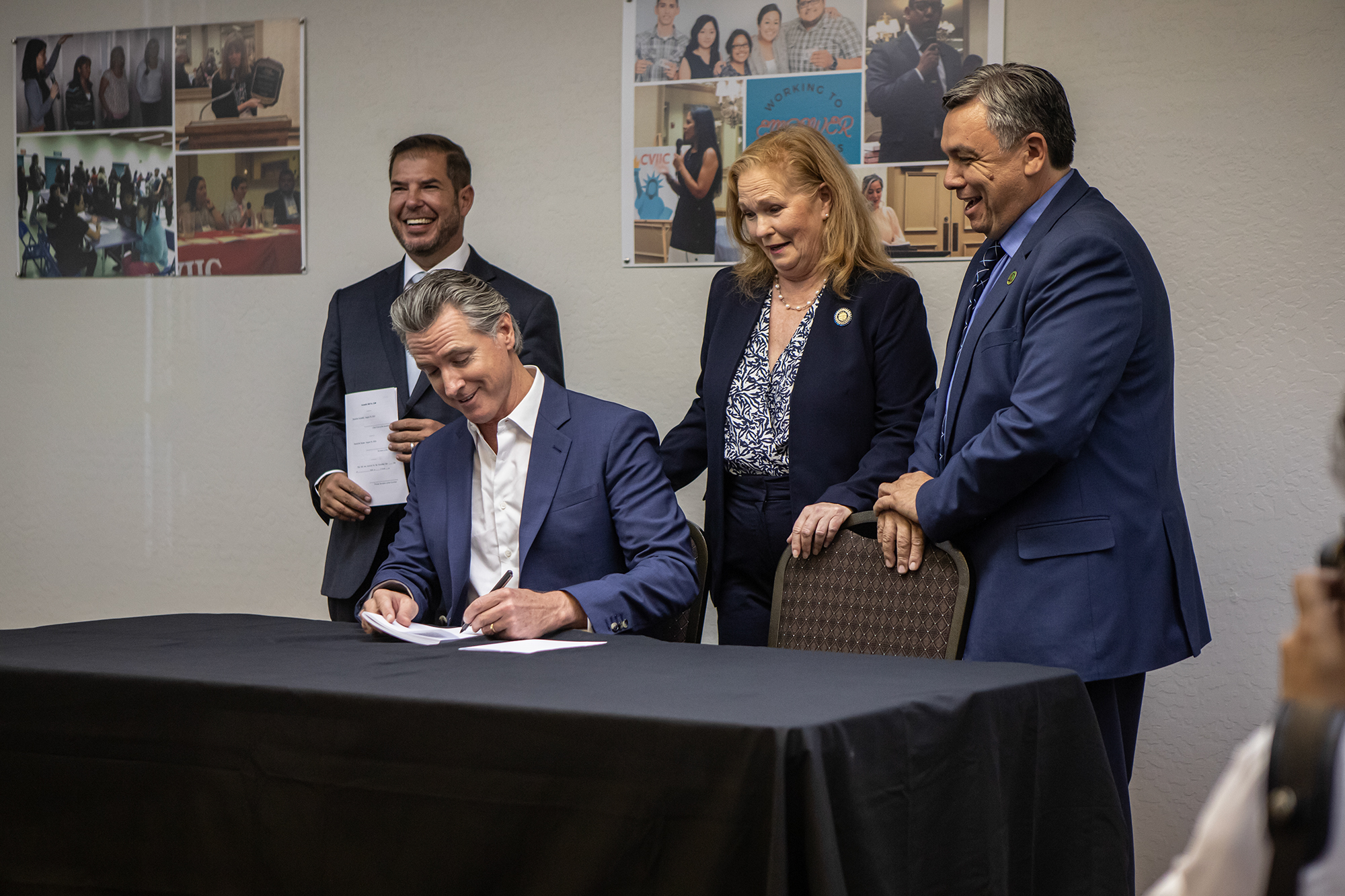
<!-- Creative Commons Attribution-NonCommercial-NoDerivatives https://creativecommons.org/licenses/by-nc-nd/4.0/ --></p> <p>from <a href=""https://calmatters.org/author/jeanne-kuang/"" title=""Posts" by="" jeanne="" kuang="" class=""author" url="" fn="" rel=""author"">Jeanne Kuang</a>CalMatters</p> <figure> <img decoding="async" width=""1200"" height=""800"" src=""https://i0.wp.com/calmatters.org/wp-content/uploads/2024/09/092424-Newsom-Bill-Signing-Fresno-LV_CM_03.jpg?fit=1200%2C800&ssl=1"" class=""attachment-post-thumbnail" size-post-thumbnail="" wp-post-image="" alt=""manager" gavin="" newsom="" sits="" at="" a="" table="" surrounded="" by="" three="" lawmakers="" behind="" him="" as="" he="" signs="" several="" documents.="" decoding=""async"" srcset=""https://i0.wp.com/calmatters.org/wp-content/uploads/2024/09/092424-Newsom-Bill-Signing-Fresno-LV_CM_03.jpg?w=2000&ssl=1" https:="" sizes=""(max-width:"/><figcaption>Governor Gavin Newsom signs both AB 3035 and AB 2240 at the Central Valley Immigrant Integration Collaborative headquarters in Fresno on September 24, 2024. Both bills would increase housing for California farmworkers. Photo by Larry Valenzuela, CalMatters/CatchLight Local</figcaption></figure> <p>This story was originally published by <a href=""https://calmatters.org/"">CalMatters</a>. <a href=""https://calmatters.org/subscribe-to-calmatters/"">Sign up</a> for their newsletters.</p> <p>It’s been a year of highs, lows and an increasingly bright national spotlight for Gov. Gavin Newsom. </p> <p><a href=""https://calmatters.org/politics/2025/02/gavin-newsom-la-fires-test/"">All eyes were on Los Angeles</a> while wildfires tore through the city in January. Newsom, having just responded to President Donald Trump’s re-election by calling a special legislative session, <a href=""https://calmatters.org/politics/2025/02/newsom-lawsuit-fund-california-trump/"">funded lawsuits against him</a>was suddenly forced to adopt a more conciliatory position as <a href=""https://calmatters.org/politics/2025/02/gavin-newsom-la-fire-aid-trump/"">he sought federal fire recovery assistance</a> which has not materialized yet. To close a severe budget deficit exacerbated by the prospect of major federal cuts, he angered some in his own party with <a href=""https://calmatters.org/health/2025/05/newsom-freeze-medi-cal-undocumented-immigrants/"">cuts to government health coverage</a> of undocumented immigrants. To study Democratic losses in 2024, he <a href=""https://calmatters.org/politics/2025/03/newsom-transgender-athletes/"">alienated progressives</a> while <a href=""https://calmatters.org/politics/2025/03/gavin-newsom-podcast-politics/"">courting right-wing activists</a> on his podcast. </p> <p>He found his way <a href=""https://calmatters.org/politics/2025/06/california-newsom-trump-national-guard/"">again as Trump’s chief opponent</a> — and a darling of the national Democratic Party — again when the president sent <a href=""https://calmatters.org/investigation/2025/07/patterns-in-california-immigration-raids/"">aggressive immigration raids</a> and <a href=""https://calmatters.org/justice/2025/06/national-guard-los-angeles/"">The Los Angeles National Guard</a> this summer. Then he <a href=""https://calmatters.org/politics/2025/11/proposition-50-newsom-spotlight/"">successfully channeled anti-Trump fervor</a> from now on campaigning for Proposition 50, <a href=""https://calmatters.org/politics/2025/11/proposition-50-newsom-election-day/"">A democratic effort at manipulation</a> to counter the president’s attempt to win new seats for the Republican Party in Congress. </p> <p>Newsom also won big with the legislature along the way, using his considerable influence over the state budget to <a href=""https://calmatters.org/politics/2025/06/california-budget-housing-deal/"">legislators with a strong hand</a> in adopting significant restrictions in environmental legislation <a href=""https://calmatters.org/housing/2025/06/ceqa-urban-development-infill-budget/"">in an attempt to stimulate housing construction</a> and infrastructure. He was negotiating <a href=""https://calmatters.org/environment/2025/09/newsom-climate-energy-overhaul-laws/"">several key climate and energy policies</a> which mostly ended the way he wanted. These efforts will allow Newsom to say this to a national audience <a href=""https://calmatters.org/environment/2025/09/climate-change-package-legislature/"">he acknowledged constituents’ concerns about affordability</a> seriously and works to reduce housing and energy costs. But he will probably get backlash for <a href=""https://calmatters.org/politics/2025/08/oil-compromise-california-legislature/"">retreat from more aggressive</a> and an environmentally-friendly stance toward the oil industry to achieve it — especially as he increasingly uses California’s tough emissions regulations and climate advocacy as a proxy for national leadership. </p> <p>But a mostly victorious year for the governor’s political profile has also been marred by scandal in recent weeks <a href=""https://calmatters.org/politics/2025/11/newsom-chief-of-staff-indicted/"">amid allegations of campaign corruption</a> filed against his former top aide. He has not been accused of wrongdoing, but the association could tarnish his reputation regardless as he looks for his next political move. </p> <h2>Outlook for 2026:</h2> <p>Next year will continue to be a challenge for the state budget as <a href=""https://calmatters.org/politics/2025/11/california-budget-lao-forecast/"">officials forecast more deficits</a>. That would limit the governor’s ability to propose any ambitious new programs in his final year in office, a time when he will have to try to make more inroads into some of California’s most entrenched problems. The persistent housing shortage, homelessness and high cost of living are likely to become baggage for Newsom if he continues to run for president after he leaves office.</p> <p>This article was <a href=""https://calmatters.org/politics/2025/12/gavin-newsom-primer/"">originally published on CalMatters</a> and is republished under <a href=""https://creativecommons.org/licenses/by-nc-nd/4.0/"">Creative Commons Attribution-NonCommercial-No Derivatives</a> license.</p> <p> Copy the HTML