Physical Address
304 North Cardinal St.
Dorchester Center, MA 02124
Physical Address
304 North Cardinal St.
Dorchester Center, MA 02124
from Alejandra Reyes-Velarde and Ana B. IbarraCalMatters

This story was originally published by CalMatters. Sign up for their newsletters.
As triple-digit temperatures scorch parts of California, two new laws aim to help educate students about and protect themselves from heat illness.
This week, Gov. Gavin Newsom signed legislation that will require the State Board of Education to consider educating students about the symptoms of heat illness in schools. Another law the governor signed in 2024 with a key deadline this month requires schools to make up rules for outdoor activities when there are extreme weather events such as heat waves.
Both are promising, low-cost measures. But none of them require the state to spend money on the things experts say would really make schools safer: updated HVAC, shade structures, a funded health program. The governor’s office says it has no plans to propose funding for an updated health framework at this time.
The laws “show that children in California are already being harmed by extreme heat,” said Sarah Matsumoto, director of policy and government affairs for Green Schoolyards America. “This is no longer a future problem. There definitely needs to be a comprehensive plan to protect children from extreme heat.”
In 2022 during a record breakingtriple-digit heat wave in Sacramento, the air conditioner in Natalie Rubio’s school cafeteria failed. She was in fourth grade; she and her classmates had to go out for lunch.
Now 13, Natalie remembers some of her peers feeling sick — flushed with red cheeks and headaches, symptoms of heat illness. She brought her experience and her idea for a bill promoting heat education to the Legislature: Assemblyman Tom Lackey, R-Palmdale, writes Assembly Bill 1653.
Adding guidance on how to teach heat illness in schools is a “simple, common sense step,” Lackey said at a legislative hearing on the bill.
“This bill does not create mandates,” Lackey said. “It just promotes awareness and prevention. Because sometimes the most powerful way to protect our students is to give them the knowledge to protect themselves.”
Heat illness is a growing concern for students, parents and educators as heat waves become stronger and longer. In California, 618 children ages 5 to 17 went to the emergency room in 2024 due to heat illness, according to Tracking California, a health monitoring tool from the Public Health Institute. That’s about a 30% jump over the previous year.
California students lost more than 40,000 hours school time in the 2025-26 school year due to closures and disruptions due to extreme heat, according to data compiled by UndauntedK12. Extreme heat accounted for 73% of weather-related school closings during the fall semester.
Natalie provides short interactive lessons tailored to each grade level and reminders during hot flashes. “I want schools to teach every student the signs and symptoms of heat illness and how to respond in a memorable way,” said the middle school student.
Lackey’s Law doesn’t guarantee new lessons—that depends on when the state next updates its health education framework. which last happened in 2019.
The Board of Education could include lessons on heat illness in its health education framework – a voluntary guide for teaching topics including nutrition, physical activity, drugs and alcohol and mental health – next time it considers updates. But no further update is planned, and that again “must be initiated and funded by the Legislature.” Marissa Saldivar, a spokeswoman for the governor, fielded questions about whether the administration would fund a new board of education framework. The board did not respond to CalMatters’ questions by deadline.
Stephanie Seidmon, project manager for UndauntedK12, said the nonprofit education advocacy group supports the law “because it’s a potentially low-cost solution at a time when our state budget is (constrained).”
If an eventual update includes heat illness education, it could make a real difference in the number of children who end up in the nurse’s office with serious symptoms, said Rosemary Dowell, chair of the California Nurses Association’s government relations committee.
Students “may not realize that that headache or that lightheadedness may not just be feeling tired, but it could be a sign of heat illness,” Dowell said. “It can give them an opportunity to respond for themselves, to respond for someone else, to encourage them to get water, find that shade, or tell an adult.”
The state Department of Education offers no official guidelines on how hot is too hot for students to be outside or how teachers should respond to unusually high temperatures. The department directs schools to a resource listincluding the state health department guidance in extreme heat, defined as more than two days and nights.
national, about 9,000 high school athletes suffer from and are treated for exertional heat each year, with most incidents occurring in the month of August. The California Interscholastic Federation, which governs high school sports, sets and may enforce heat-related policies, including rules regarding practice times and hydration breaks for student-athletes.
Senate Bill 1248authored by Sen. Melissa Hurtado, D-Bakersfield, requires schools to adopt protocols for outdoor activitiessuch as sports training and rest, during extreme weather. This includes setting criteria for when schools should cancel outdoor activities. The death of 12-year-old Yashua Robinsonwho in August 2023 collapsed and died during a PE class in Lake Elsinore, challenged this law.
The law requires schools to develop heat safety plans that include monitoring weather forecasts, identifying safe indoor alternatives to outdoor activities and training staff to recognize heat stress, among other measures. The law requires schools to have these plans ready by July 1 of this year.
In a legislative hearing in 2024, Yahshua’s mother said her son died following unsafe school rules.
“It was nineties outside that day and even the best and most well-trained athletes wouldn’t run in it,” she said. “Yet Yahshua’s class of middle school students were made to run in this heat. Physical education should only take place in an environment conducive to physical activity.”
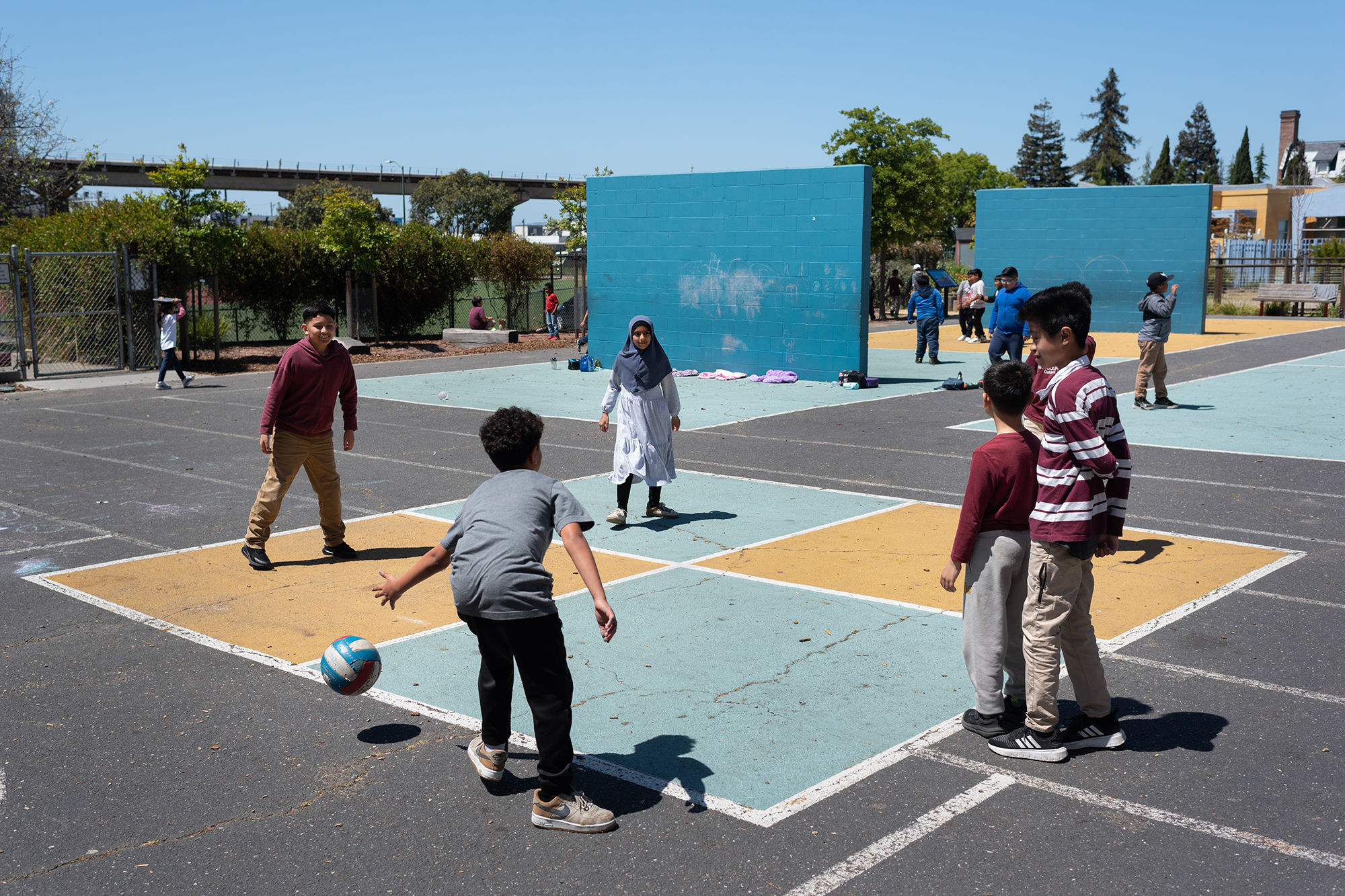
School and environmental advocates want state leaders to go further by investing in better cooling systems and more shaded areas for children to play. But limited state and school funding stands in the way.
“Many of our school buildings were built before the era of extreme heat fueled by climate change,” Seidmon said. “Our children play in playgrounds, in schoolyards and on fields that have no shade… So it is extremely important that our school buildings and grounds protect our children from extreme heat.”
Emily Penner, associate professor of education at UC Irvine, is study of the effects of heat exposure about students and how schools are adapting to warmer days. The answer, she learned, varies greatly by region—schools that have long struggled with extreme heat are more likely to try new approaches, such as using more heat-resistant materials for playgrounds and prioritizing air conditioning on school buses.
Adaptation efforts such as shading and HVAC infrastructure in most schools can make a significant difference, Penner says. At the same time, these projects require funding that many schools may not have.
“This is a case where we have some pretty specific things that we know we need to do, like putting HVAC in most schools across the state, and now we have to figure out how to organize political support for something like that,” Penner said.
Even when funding is available, schools find it difficult to secure or insufficient to meet needs. In 2020, the Legislature created a state program known as CalShape, funded by utility ratepayers, that helped schools pay for assessments and upgrades to their air conditioning systems. But the program’s administrator, the California Energy Commission, abruptly halted applications in 2024, citing budget constraints. The state will return the remaining $200 million to investor-owned utilities if the Legislature does not act by the end of the year.
In 2024, Californians voted to approve Proposition 2, a bond measure that set aside $10 billion for school facilities. But school modernization projects already search more than the financing provides.
Voters also approved Proposition 4, which sends another 10 billion dollars for climate projects across the country. That includes $50 million for the state’s Urban Forestry Program, which directs money to local projects that add green space, including in schools.
“Compared to the federal government and many states, California is one of the leaders on this,” Matsumoto said. “And we still haven’t collectively met the moment.”
Supported by the California Health Care Foundation (CHCF), which works to ensure that people have access to the care they need, when they need it, at a cost they can afford. Visit www.chcf.org to learn more.
This article was originally published on CalMatters and is republished under Creative Commons Attribution-NonCommercial-No Derivatives license.